
Verizon Family Innovation
Verizon Family is an app-based service for postpaid customers that provides location sharing, safety features such as SOS and Safe Walk, and parental controls including content filtering, screen-time management, and call and text monitoring. The platform offers a free tier and a $14.99/month Verizon Family Plus subscription, which adds advanced location alerts, driving insights, roadside assistance, and Family Line (a shared phone line).
As Lead Experience Designer II, I drive UX strategy and innovation across the Verizon Family ecosystem—balancing strategic vision with hands-on execution and team mentorship. My work spans critical safety features such as Roadside Assistance, SOS/911, Safe Walk, and Crash/Fall Detection, as well as Parent Education and device experiences such as Gizmo Phone. I also design support experiences such as Gizmo Watch, FAQs, how-to guides, expert tips, and feedback tools. A key focus of my role is reducing reliance on documentation by creating more intuitive, in-product experiences.My Role
- Lead Experience Designer II
- Sole Contributor
- Build UX Research Materials
- Feature Research
- Innovation Strategy
- Visual Design
- Data Organizing
- Prototyping
- Wireframing
This innovation initiative explored how we could leverage existing capabilities within the Verizon Family app and the broader Verizon ecosystem to establish a strategic partnership with Disney Parks while also enhancing our offerrings to our general customer base. One concept I developed was a feature called Shepherd, designed to combine our location-sharing functionality, geofencing technology, and Gizmo Watch ecosystem to create a safer environment for children and aging adults exploring large venues like theme parks. The goal was to extend our platform into real-world family experiences—enhancing child safety while providing parents with greater peace of mind through intelligent, location-aware features.


Problem
Large, crowded environments such as theme parks create a tension for families: children and aging adults want the freedom to move independently, while guardians need reassurance that loved ones remain safe and within reach. Traditional geofence technology is limited because it relies on fixed coordinates or addresses. While this works for static locations like homes or schools, it is less effective in dynamic environments where groups are constantly moving.
For families visiting large venues like Disney Parks, guardians often feel the need to remain hyper-vigilant to ensure children or aging relatives stay nearby. This constant monitoring can diminish the overall experience and introduce moments of panic when someone temporarily moves out of sight.
Research
1. Missing Children in the United States
Roughly 460,000 children are reported missing each year in the U.S. according to FBI NCIC statistics.
In 2024 alone, the National Center for Missing & Exploited Children assisted law enforcement with 29,568 missing child cases.
About 2,300 children are reported missing every day in the United States across multiple categories (runaways, family abduction, lost children, etc.).
Important context:
Most missing children are runaways or family custody disputes, not stranger abductions.
However, large crowded venues (malls, festivals, theme parks) are common places where children become temporarily separated from parents.

2. Children Lost at Disney Parks
Reliable numbers are limited because Disney doesn’t publish official statistics, but several sources indicate:
~15/day or 5,475/year children become separated from parents in Disney parks due to crowds.
Disney parks receive 140-157 million visitors annually, creating frequent temporary separation incidents.
Reports emphasize that the vast majority of lost children are quickly reunited with their parents due to park safety protocols.
The key insights:
The problem is not abduction inside the park — it's temporary separation and panic in massive crowds.
This is exactly the type of problem geofencing + location awareness can solve.
Solution
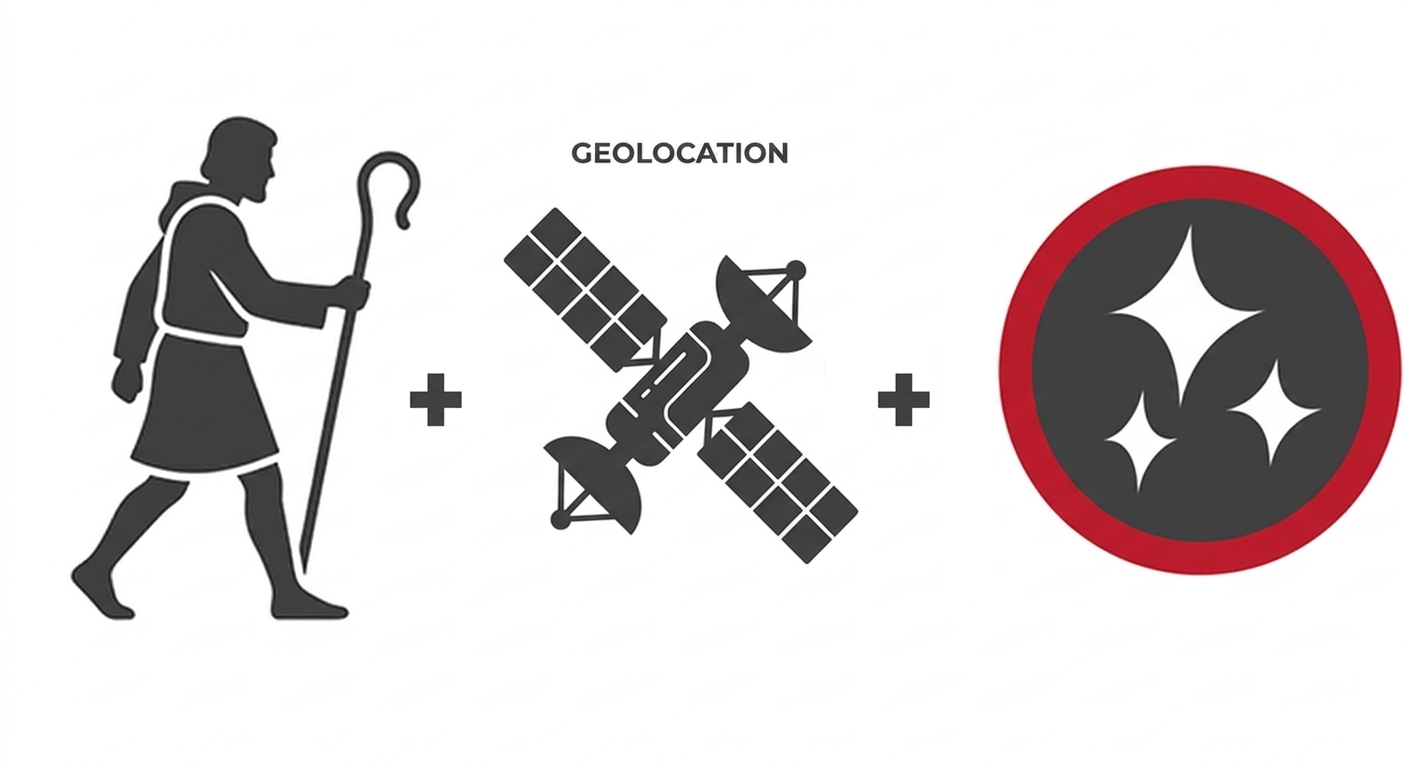
While traditional geofencing is stationary, families themselves are mobile. If the safety boundary could move with the group rather than being tied to a fixed location, it would better reflect how people naturally travel and explore together.
Verizon already had several technologies capable of enabling this concept:
Location sharing within the Verizon Family app
Geofencing capabilities
Gizmo Watches designed for children
Verizon pet tracker devices
Additionally, advances in agentic AI presented an opportunity to simplify setup and provide intelligent guidance during safety events.
By combining these capabilities, Verizon could create a mobile safety ecosystem that actively supports families in real-world environments.
Concept
I developed a concept called Shepherd, a mobile geofence system that creates a dynamic safety perimeter around a guardian’s mobile device.
Instead of placing a geofence around a fixed address, Shepherd establishes a moving boundary that travels with the group, effectively behaving like a shepherd guiding the flock.
The system integrates multiple Verizon technologies to support different family members:
Smartphones for guardians, children and aging adults
Gizmo Watches for children and aging adults
Pet Tracker devices for pets
Location-sharing technology for family members
To enhance the experience, I integrated an agentic AI model into the system.
The AI serves two key functions:
Intelligent Setup
The AI assistant helps guardians quickly configure the mobile geofence by recommending appropriate safety radiuses based on environment, crowd density, and device location signals. This reduces friction during setup and makes the feature accessible even for less technical users.
Real-Time Monitoring and Guidance
If a child, pet, or aging adult moves beyond the defined safety boundary, the system sends an alert and the AI agent provides contextual guidance on next steps—such as suggesting navigation directions, highlighting the last known location, or prompting the guardian to initiate contact.
This transforms the feature from a passive alert system into a proactive safety assistant.
Tara: My twin sister and I drive the same make, model and year car. We compete at everything, so, our 2-week driving scores are about the same. But her discount... is so much higher than mine.


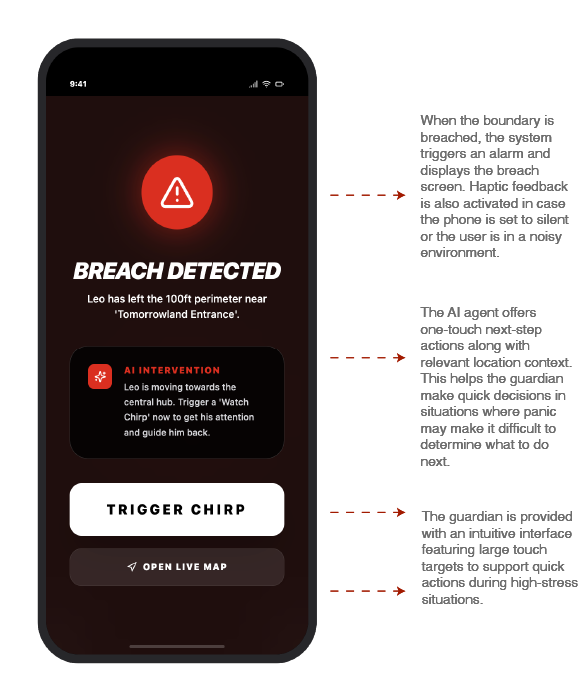


Business Benefits of the Shepherd
(with Gizmo Watch Rental + Premium Package Integration)
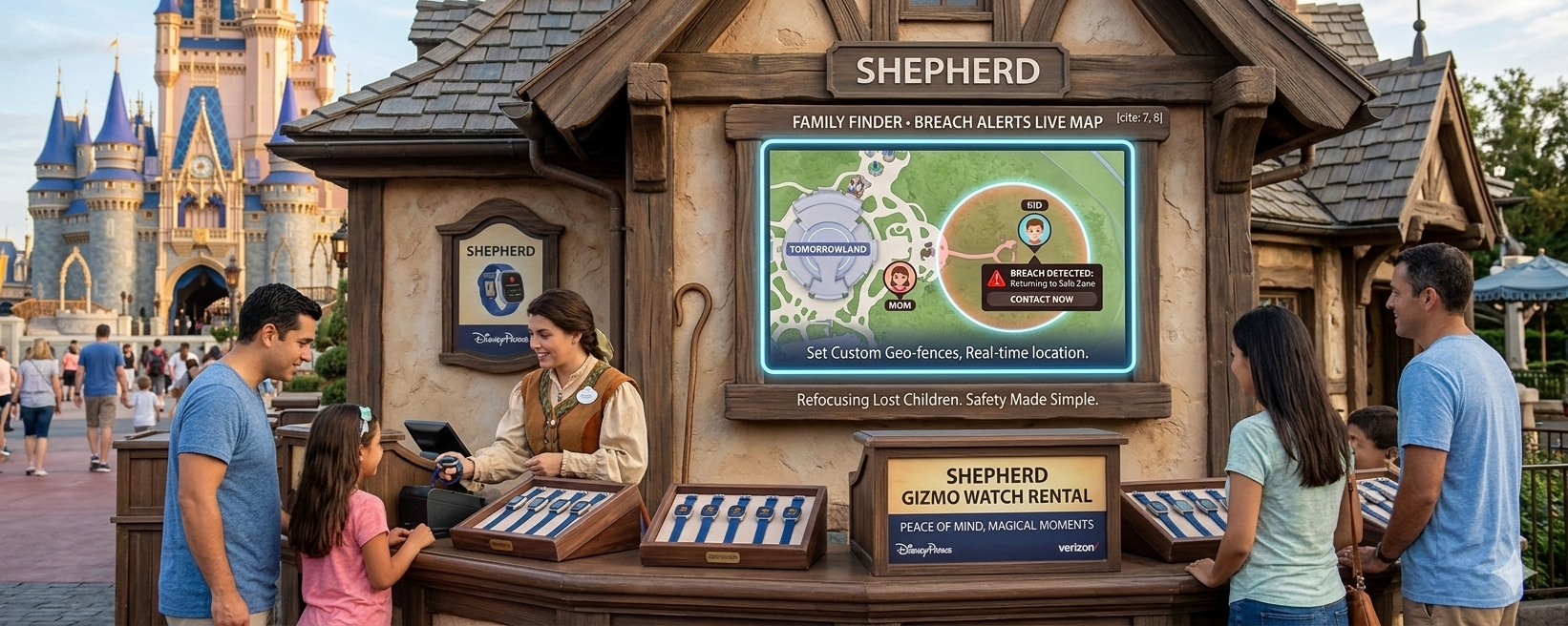
Benefits for Verizon
1. New Device Revenue Through Park Rentals
Disney parks could offer Gizmo Watch rentals to families visiting the park,enabling children to participate in the Shepherd safety ecosystem.
Possible models:
Daily rental fee (e.g., $4.99–$9.99 per day)
Included with premium Disney park packages
Bundled with Verizon Family trials
This creates a new revenue stream for Verizon hardware while also expanding exposure to the Gizmo ecosystem.
Benefits for Disney Parks
New Revenue Stream
Instead of treating lost-child incidents purely as an operational cost, Disney could monetize safety through optional services.
Examples:
Daily rental fee
Premium safety add-ons
Family safety packages
This turns a liability cost into a self-sustaining program.
